Hack your recruitment week · for talent acquisition leaders
Your team is not behind on AI. It is divided.
Two days in your own office, with your whole team, on the tasks in your week you dread most.
Twenty minutes. We scope it around your team and your workflows.
Can you run AI training in person at our office?
Yes, at your office, wherever that is. We work across the EU and travel outside it, and we agree the format with you first so the travel does not cost more than the training. Two days with your whole recruitment team, in English or Dutch, followed by half a day six weeks later. One price for the programme, not per seat.
The reference
Before the bootcamp, we were using AI here and there, mostly for writing and summarising, but without any real structure or depth behind it. Not everyone came in feeling ready. Some team members were genuinely anxious, worried that keeping up with AI meant becoming an engineer.
Over the two days, the team went from scattered experimentation to actually building and prototyping AI-powered recruitment workflows that felt genuinely usable.
What surprised me most was what happened to the people who were most nervous coming in. By the end of day two, they were not just comfortable. They were the ones initiating ideas. That complete reversal in two days is something I honestly did not expect.
To any TA leader considering this: do it, and bring everyone. Especially the ones who think it is not for them.
Diana Kryshevych
TA Lead · twelve people in the room, two days, their own work
The problem
The problem nobody puts on a slide.
You already know who in your team is ahead. Two or three people are deep in it, running their own experiments, sending you links.
You also know who is quiet. Not resistant, not lazy. Waiting. Hoping the subject moves on, or that someone else will figure it out first.
That gap is the actual problem. Your team does not need more information about AI, there is plenty. They need to have done it once, together, on work that is really theirs.
It is also why sending one person on a course makes things worse. They come back fluent, the rest feel further behind, and your department now moves at two speeds instead of one.
Left alone, the gap does not close. It hardens. The two who are ahead start routing work around the rest, the quiet half stops asking questions in case the answer is obvious, and a year from now you are not running a talent team, you are running two of them.
What your team walks out with.
At least three working things they built themselves. Rough, but running, and on their own material. That one is guaranteed.
The confidence to keep going after we leave. That part is harder to teach than any workflow.
Everyone in the room ends up with the same idea of what AI can and cannot do. Your next meeting about it is a different meeting.
Less waiting on vendors for the things that should already be running.
And you will know something you did not know on Monday: who in your team has this in them.
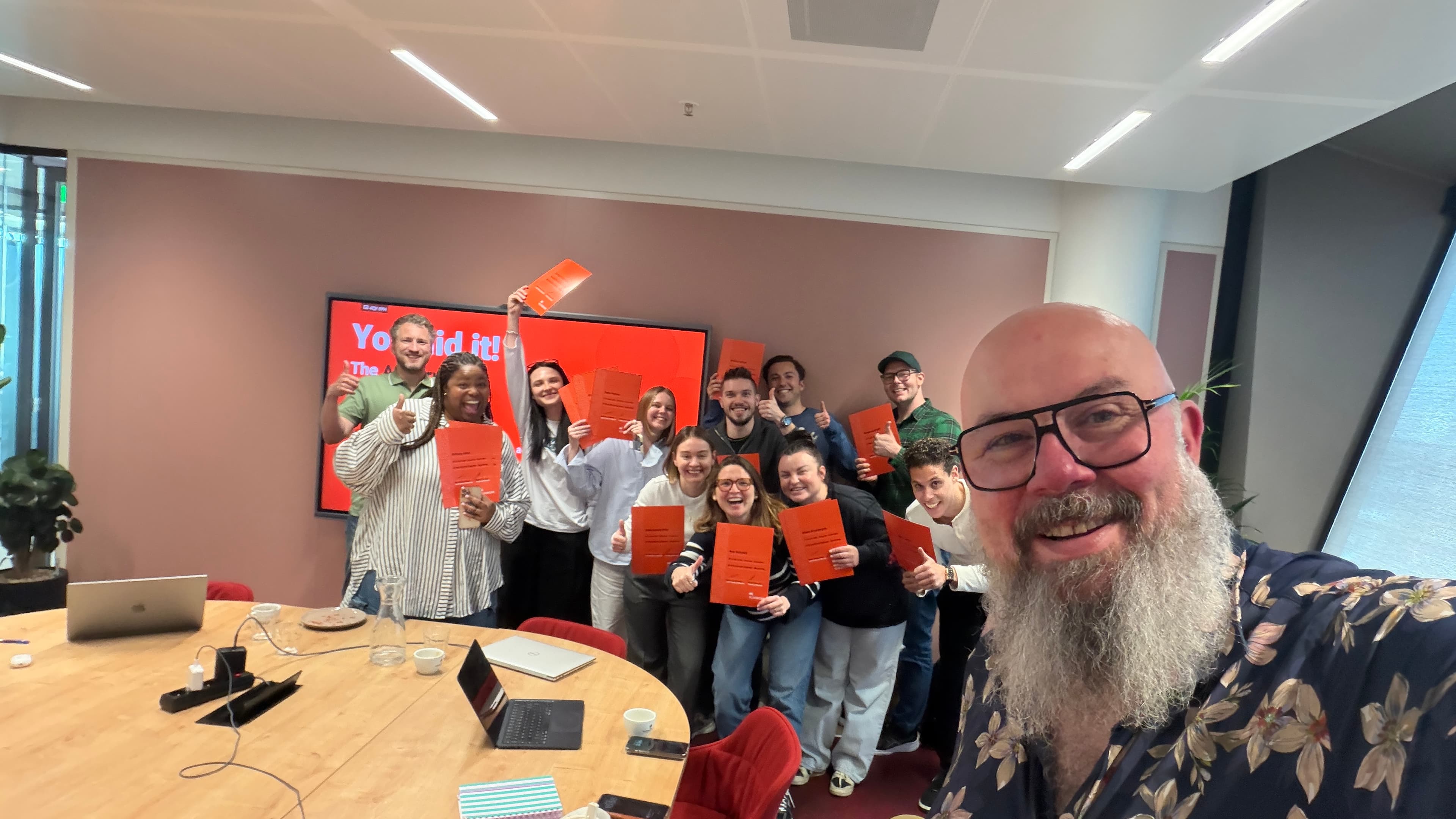
A full recruitment team. Two days. Three working things shipped.
Inside the two days
Their own work, from day one.
Nobody builds a case study. Everyone builds the task they told us they dread.
The intake. We speak to you, and we ask every participant one question: which task in your week do you dread most. That answer is what they bring. No generic case studies, no sample data. We also check what your team can actually log in to, so the morning is not spent on access.
From scattered to structured. Everyone gets something working on their own material before lunch. Not a demo of ours, theirs.
Building. Small groups, real workflows, and both of us moving through the room. At the end each group shows what they made to the rest, and to you.
The return. Half a day. What survived, what quietly died, and what is worth putting into production. This is the part everybody skips, and it is the reason most training days are forgotten by the following Monday.
After the two days
What changes.
Your team can change what it built, because they built it.
The quiet half has an opinion now, and it is usually a good one.
Recruiters stop managing tools and start managing pipelines.
Ask five of them how they use AI on an intake and you get the same answer.
Are we describing you?
You are here if...
- Your team is split. A few are ahead and the rest are quiet, and you want them in one room.
- Some of your people think this is not for them. Especially then.
- You want a shared baseline across the whole team, not one person on a course.
- You can free up two days for the department.
- You have at least one task the team does every week and nobody enjoys.
Skip this if...
- Your team is already building and wants to go deeper into engineering. That is a different programme and we will point you to it.
- You want a talk about where AI is going. There are cheaper ways to get one.
- You want to send one person. Do that first, then come back when you want to move the department.
We run it on the tools you already have
Corporate laptops, tenant restrictions, an IT department with an opinion. We have met all of it.
The two days run on what your team already has access to. If that is Microsoft Copilot, we work in Copilot. If you have a broader stack, with workflow automation in n8n or something like it, we use that. The exercises are built so the thinking survives the tool.
We check this in the intake, not on the morning itself.
About the rules, honestly
Under the AI Act, the obligations for AI used in recruitment and selection apply from 2 December 2027. The AI literacy provision has applied since February 2025. Separately, and already in force, the GDPR requires that whoever reviews an automated assessment both understands how it works and has the authority to overrule it.
We are not lawyers and we do not sell compliance theatre. You may notice that some providers quote fine amounts for AI literacy that the regulation does not actually support. What we do is make sure your team knows where the line runs while they work, so that what they build does not have to be unbuilt later.
Who delivers this.

Marcel van der Meer
The AI Recruitment Expert
Marcel has spent 20+ years in recruitment, training more than 10,000 recruiters across six continents on how to actually use AI in daily work. Along the way, the same pattern kept showing up. Tools were not the bottleneck. The setup was. Full bio

Michiel Wiersema
The Sourcing Automation Expert
Michiel combines deep sourcing expertise with AI automation. He designs and builds the workflows that make sourcing pipelines actually run, using n8n and AI agents to automate the parts recruiters should not be doing manually.
Always two of us. One person cannot carry a room where every group is building something different, and this is a room where every group is building something different.
That is also why we run four of these in a quarter. Not four a month, four a quarter. Two trainers, two days, and an intake with every participant does not scale, and we would rather say that than pretend otherwise.
If you are planning for the first half of next year, the conversation happens now, not in January.
From the open bootcamp
One seat at a time.
More than 500 recruiters have been through our AI training, one seat at a time.
Iris Redegeld, lead corporate recruitment at Royal Van Lent Shipyard, came through the open bootcamp. She describes building sourcing workflows and automations, up to a tool for market analysis, all of it directly usable on her own work. Two colleagues came through as well, across two editions.
That is how it usually goes, and other companies have done the same: three or four people, one at a time, months apart. It works. It is also the slowest possible way to change how a department works, and it is the reason this two-day version exists.
What we guarantee.
Every team leaves day two with at least three working things they built themselves.
Not slides. Not a list of ideas for later. Three things that do a piece of real work, made on your own material, in the tools your organisation actually allows you to use.
What the last team built: a sourcing tool that runs on its own, a scheduling tool, and a dashboard. Worth knowing that they had unusually free access to their own systems, and most teams do not. In a tighter environment the three things look different, and we work out what is reachable in the intake, before anyone commits to anything.
If that is not true at the end of day two, we come back for a day at our own cost until it is.
Not sure yet where your team actually stands, take the AI recruitment readiness check first. Two days is the programme. If your team genuinely cannot be away for two days, say so on the call. There is a one-day version, Hack your recruitment day, with a smaller promise: everyone touches it once, and you find out who in your team has this in them. It is not this programme in half the time, and we will tell you honestly where the difference sits.
What it costs.
Sending twelve people to an open two-day AI course runs between 1.299 and 1.799 euro per person, and only the people you picked go. A team of twelve here lands under the cheapest of those per head, and nobody is left behind at the office.
One price for the programme, not per seat. The moment it is priced per person you start choosing who comes, and choosing who comes is exactly the mistake.
You get the number in the call, once we know how many people and how many days.
Twenty minutes. We ask what your team looks like and where they are now. If it is not a fit we say so.
For the person you have to convince.
You may not be the one who signs. Here is the version to forward, and you are welcome to send it exactly as it is.
Our talent team uses AI unevenly. A few people are ahead, most are waiting, and that gap is starting to show up in how work gets divided. Rather than sending one person on a course, I want to put the whole team in a room for two days and have them build on our own vacancies and our own processes, in the tools we already have. They come out with at least three working things they made themselves, and we get one shared standard instead of five private habits. The obligations for AI in recruitment and selection under the AI Act apply from December 2027, so the team knowing where the line runs is not a nice-to-have. This is not a training day, it is the first concrete step of our own AI plan.
If your organisation books this from an innovation, project or department budget rather than from learning and development, you are in good company. Most do.
Try this before you talk to us.
Ask your team one question this week, in writing, so the quiet ones can answer without anyone watching:
Which task in your week do you dread most?
Then look at who answered in one line and who wrote you three paragraphs. That tells you more about where your department actually is than any AI readiness assessment will.
It is also the exact question we ask in our intake. If the answers make you want to do something about it, that is the moment to talk.
Questions answered.
Next step
Bring everyone.
Hack your recruitment week. Two days, your whole team, your own work.
A short call, twenty minutes. We ask what your team looks like, where they are now, and what the quiet half is quiet about. If it is not a fit we say so.
Especially the ones who think it is not for them.